It took me the better part of 10 years to watch 2001 the whole way through. Every time I tried to vocalize to someone what made me stop watching it I would seize up with an indescribable knot of dread and worry. Apparently something so awful had caused my brain to malfunction every time I tried to watch it and eventually rendered me incapable of articulating why I couldn't watch it all the way through. What was this demonic force?
Well, on Sunday November the 1st 2015, taking full advantage of Daylight Savings Time, I decided to put the film to bed once and for all. And within minutes I knew exactly what that demonic force was.
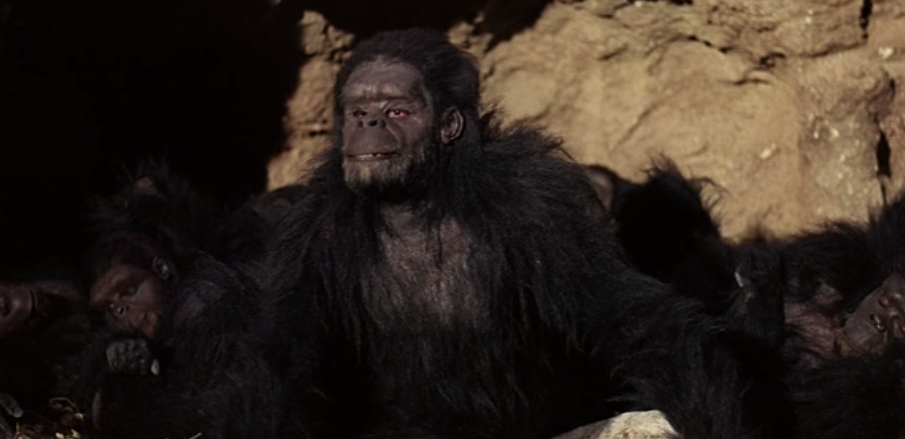
Real people in ape suits.
What the fuuuuck these things are the worst. I now remember it as clear as day. Frickin apes, doing ape things...who look basically like normal apes for a little while and then all of a sudden... oh hell no hell NOOOOOOOOOOOO! This face happens and then everything is ruined.
The ape scene lasts about 25 minutes which perfectly explains why I could never get very far in watching this. Luckily now that I'm like old and stuff... :/ I can look past the apes (or play games on my phone while I wait for them to go away).
Looking back now after having watched the entirety of the film though, I think it's safe to say that the actual root of my inability to watch it all the way through was that I was not prepared for its epic silence. Talking is not a thing that happens for awhile and then later talking stops again and again and then there's a psychedelic trip and a weird baby in a bubble and my head explodes. The film takes that silence and thrives on it. It also uses music to push your buttons to extreme places.
Every time the monolith came on screen and that chorus of what I suppose was created by a group of possessed monks filled my ears, I wanted to crawl under the sofa and die a little. It's so jarring and upsetting. And sure, we might not know what the hell is happening most of the time, but damn it again, 2001 is simply just beautiful.
I'm glad I finally got all the way through it and that I can now wallow in agony over my inability to understand it. I still wish the apes had never come. But then I guess humanity would have been lost. So damn it. Damn you................................... apes.
I think I have a problem. My doctor said not to worry but it keeps itching and……okay fine I'll tell you. It seems that after 27 years of existence, I cannot stop watching movies about the Vietnam War. Totally weird right? Movies about puppies sure. Romantic comedies---could be worse. But Vietnam? WHY am I glued to the TV like an oily handprint? Why do I find myself watching the same movies over and over and over again. I'll tell you why. Unlike most other war movies, movies about the Vietnam War somehow seem more relevant to me. The themes, the artistry and underlining message in these always sparks a truly unique reaction within me.
Previously my obsession began when watching Apocalypse Now for the first time and deciding that it embodied my ability to embrace horror movies as a way to disintegrate the fear. Last night, I noticed Full Metal Jacket was playing on IFC and I got all excited again. When I was younger, I watched Full Metal Jacket and thought I felt some inkling of genius. I lacked the real brain power to put the pieces together but the important thing was---the movie spoke to me. Me-- a kid without the slightest knowledge of the Vietnam War aside from what I learned in Forrest Gump. Imagine that.
So after watching Full Metal Jacket not once but twice in two days, I've come to appreciate it more than I ever thought I could. Putting aside the obvious motifs about military brainwashing, the inherent evil of the Vietnam War, and the duality between love and war---I'm more interested in the 1,000 yard stare.
A concept brought to the public thanks to Tom Lea, who emphasized the horrors of war and the lasting effects on the soldiers in his painting, "Marines Call It That 2,000 Yard Stare". The 1,000 (or 2,000) yard stare signifies a kind of deep, traumatic understanding. It represents the idea that there are two kinds of people. The ones who see and the ones who do not. The ones who have been there. And the ones who have not.
The 1,000 yard stare is brought up in Full Metal Jacket when Joker claims he's been in combat--but others disagree citing that he lacks the 1,000 yard stare to have been there. By the film's end, Joker makes a decision to end the life of the wounded teenage girl sniper and then at that moment develops the iconic 1,000 yard stare. It's important to note that after all Joker has been through---the horrors of boot camp, witnessing Pyle murder Sergeant Hartman and then blow his own brains out,
seeing Vietnam Civilians carelessly killed and discarded like an afterthought, his best friend getting shot----Joker does not develop the 1,000 stare until made to look death straight in the face.
On the opposite end of the spectrum, Gomer Pyle developed the 1,000 yard just by caving in to his own weaknesses.
Pyle's essentially bullied until his mind can no longer take the fact that he's stuck in 'a world of shit.' The truly fascinating thing then is that the 1,000 stare doesn't need to be restricted just to those experiencing war and the horrors of combat. It's life fool. I'm not trying to make light of the depth of the 1,000 yard stare and its true meaning but I'm just saying that I think it's bigger than that. And I think Kubrick was trying to point this out. It can't be a coincidence that one of his iconic filming techniques is dubbed the "Kubrick Stare" right?
I still think there's something much more chilling about Pyle's 1,000 yard stare than Joker's. I think it's the revelation that Pyle sees himself stuck in a world of shit and unable to get out. A desperation of the mind encountered by those who are suicidal. Joker on the other hand while still admitting he is in a world of shit, grows from it and becomes stronger. Seeing the surrender of Pyle chills me and continues to chill me long after the moment has passed and the credits roll.
The real horror of Full Metal Jacket is that more people aren't like Pyle. Not in the sense that they didn't kill themselves but because everyone else seems to have an ability to turn off their mind and just kill and be OK with it. The end scene for example, after having killed a teenage girl sniper, the soldiers march off into the flames while singing the Mickey Mouse March.
It's a scene so jolting that I instantly compared it to the end of Salo. The scene where after senselessly torturing a group of children and teens, the soldiers start up a friendly waltz with each other--blissfully ignoring all the crazy shit they just did. It's enough to make you crazy. And I think that's at the heart of the sadness of Pyle. The ability to realize that you're not made of what they want you to be made out of.
Clearly I've lost my train of thought and am just rambling now but that's what happens when movies about Vietnam and I get together. It's like an Italian Horror movie. It starts out making sense and then all of a sudden, a man is dressed as a woman and a monkey walks in with a telephone, while a midget recites poetry.
So, apologies for this rant. But my mind is doing this crazy thing where it can't stop thinking and wondering and loving and battling. Life man. Life is hard. You've either seen it, or you haven't. The trick is---what will you learn about yourself once you have seen it?
I'm not sure if I'm supposed to like A.I. as much as I do but then again, I'm pretty sure I'm not supposed to like The Chipmunk Adventure as much as I do either and nothing's stopping me from watching that at least 3 times a year. A.I was one of the first films I saw that made me appreciate film. Not in a "Dude, this movie is awesome!" way but more like in a "Wow look at that shot, that is a brilliant shot!" way. Some may refer to this day, as the day I received my license to be a pretentious snob about film but I like to refer to it as the day my eyes opened.
A.I. gets a lot of flack for some reason. In my opinion, the brunt of the flack comes from the idea that Spielberg ruined what was presumably Kubrick's vision. People seem to look at the film for what it could have been rather than what it is. But are they right? Did Spielberg really ruin the film or do we automatically make that assumption because of who Kubrick is? A filmmaker who thrives on the importance of perfection can not possibly be matched up with the man responsible for making Indiana Jones and the Kingdom of the Crystal Skull right? Wrong.
I love Steven Spielberg and I love Stanley Kubrick. Luckily, most of the people I associate with have a similar mindset and the world can go on turning peacefully. The thing about A.I. that people forget is that Kubrick wanted Spielberg to direct it. The film was born sometime in the 70s as Kubrick began his adaption of Brian Aldiss' short story, Super-Toys Last All Summer Long.
In 1985, Kubrick brought on board Steven Spielberg to be the film's producer. While the film cycled through various writer's it ultimately landed itself in nowhere-ville until finally having the story completed in 1991. In 1995, Kubrick ultimately decided that the film was closer to Spielberg's sensibilities and handed the project over to him. Spielberg however decided on directing other films and convinced Kubrick to stay on as director.
We know how the story goes from there, Kubrick chose to focus instead on Eyes Wide Shut and then died in 1999 before the film was released. This meant that the start of a very intriguing and intelligent film was left behind with no one left to direct it except the one man that could.
So with the colorful history of A.I. comes people's perceptions about this and that and how much of the film was really Kubrick's and how much of it was Spielberg's. The thing is though, most of the film is really still Kubrick--and you can tell that it is. After the film was released and people got all crotchedy about what they perceived to be a poor film due to "Spielberg taking over a Kubrick vision", everyone made assumptions. They assumed that Spielberg added in all this cheesy, emotional business. It's a fair call to make since we all know how Spielberg likes to mix in heartbreak and sadness with his Science Fiction. BUT listen to this: it was in fact Kubrick's vision to have the story go to places of emotional upheaval. The beginning, and the end--the most emotional bits in the film were all Kubrick.
Spielberg says himself, "it was Stanley who did the sweetest parts of A.I., not me. I'm the guy who did the dark center of the movie, with the Flesh Fair and everything else. That's why he wanted me to make the movie in the first place. He said, 'This is much closer to your sensibilities than my own."
So yes, Spielberg took the vision and made it his own, but there is still a strong sense of Kubrick emanating from much of A.I. Can't you feel it? It's in the simplistic way that the film is shot in its beginning and end. There is this amazingly pure feeling there, that isn't compromised by anything. There are so many shots that are just...nice. I can't even describe them.
We may not have an exact account of what was what, but there was a fair amount of concept art and storyboarding that happened before Kubrick's death which always makes me feel that Spielberg was in essence working off of a cheat sheet. A really awesome cheat sheet.
I enjoy the beginning of this film so much that sometimes it's hard to explain to people why I do. So far I've come up with this--there is so much love and sadness going on, but it still looks and feels so beautiful. I think this movie gave me one of my first girl crushes ever, Frances O'Connor, WHERE HAVE YOU BEEN?
Everything about these opening moments is so calculated in this almost effortless way. The idea of the entire film acting as a modern (futuristic) fairy tale. The ever apparent theme of Pinnocchio, the Blue Fairy and becoming a real boy.
The overarching idea or conundrum of a robot boy being capable of loving, and the problem that he may be the one that needs the loving.
Hayley Joel Osment gives one of his best performances here---he is at once inhuman and startlingly human. It makes my head hurt when I think about it.
This scene, is responsible for making me want to take up acting.
Which I have since stopped after realizing I was bad at it. Some may group it in the "overly emotional" side of things but I disagree. This gives me chills, why does it move me so much? I'm still trying to figure this out but I'm guessing it has something to do with my heart or something.
And then we arrive at what is probably my favorite scene of all time. Or shot I guess....my favorite shot of all time, is a steady shot of Jude Law's robot face, glowing against the backdrop.
Stop laughing alright. I don't love this because it's Jude Law mmmmk. There's just something about this that I find so unbelievably mystifying. He really looks like a fucking robot, I mean he doesn't blink.
And then of course get arrive at what is apparently Steven Spielberg kingdom. When you step into the Flesh Fair, you feel like you've taken a wrong turn--and you should feel that way.
Up until now, all we've had to really look at it is the love and sadness of one family. Just as David is being pushed out into the world, so are we as viewers for the first time experiencing the outside. It is here that we get a first account of that "civil war" between robots and humans. The Flesh Fair is flashy yes, and it's very Spielberg with its flashy dog motorcycles and neon lights and fucking robot Chris Rock in a cannon.
This doesn't mean though that it destroys any part of A.I. So it's different, so what? I still find it to be moving in its own way. The scary treatment of robots, and the showmanship involved in tearing these machines apart is so trashy--yet is participated in by all these...normal people. It makes me feel bad for robots!
These broken and old robots. The robot in the doctor's coat, the robot stating that he still works fine he just needs a repair. Isn't it sad?
Maybe I'm just a softie, but if the whole concept behind Artificial Intelligence is the power of David and the power that he has to love--I can't help feeling like all these other robots have a certain amount of life too.
If we look at Gigolo Joe for example, a robot also created to "love" but in a very different way, we realize that aside from the fact that Joe does not have a mother--we still end up feeling an attachment to him. We still value Joe as we would value David don't we? The robots in A.I. in that way are people, and they are strong characters.
A.I. may be over 2 hours long, but it doesn't prevent me from becoming lost in the entire film and watching it all without stopping. I love the evolution of David's character, and the strange journey to find the "blue fairy".
Who by the way is voiced by Meryl Streep, who got top billing and spoke for maybe 3 minutes in the entire film. Forgive me, but yes the Flesh Fair may have been Spielberg's only real contribution, but there's no way in hell Stanley Kubrick would go for paying Meryl Streep all that money just to read a couple of lines. Just throwing that out there.
Anyways, I love how fucking sad everything is but how oddly happy everything becomes by the end. A.I. is actually one of those movies on my instant tear jerking list. I always try REALLY hard not to cry at the end but damn it. I can't help it if it's moving okay? I can't help it if I feel truly sad for David and what he has been through.
I never really understood the end of A.I. until watching again recently. The film, like most films I've seen between my youth and now has a much different meaning now.
It's one of those rare films that will affect you differently each year that you grow older and I love that. Sure, the bulk of what I was feeling there at the end had mostly to do with my cat, but one of these days I'll probably be a mother and then what? Niagara Falls my friends.
So yes. I love A.I., and I hope that some of you do too. It may have a few hiccups here and there, but I still feel like it is one of the most important films I have ever seen. Is that weird? Should I be saying that Citizen Kane or 12 Angry Men is the most important film I've seen? Probably. But I'm not, and therein lies the difference between them and me. There's something about A.I that truly and utterly moves me. The feeling like I'm watching something done right.
All in all, A.I. is one of the most unique films out there. Imagine a film that was conceptualized by one man up until his death and then taken over by one of his best friends. The results by all accounts should be sloppy. Here though, the results are inspiring. Kubrick's spirit still seems to survive in the world of A.I., with a few nods here and there to Spielberg's style. Ultimately though, A.I. smells very strongly of Kubrick, a haunting glance back into a man that we lost only years before. It's like those odd moments when you walk into a room and swear that someone who had died, was just there minutes before. A.I. captures that essence and proves that it is indeed a Stanley Kubrick film after all. Creepy, beautiful and sad: A.I. in a nutshell and I have a feeling I'll never be able to let it go.
NOTE: There is nudity in this post because some of the movie takes place at an ORGY...
I have a confession to make: I completely and utterly love Eyes Wide Shut. Yes its true. Somewhere past the age of 14 when I stopped watching it solely for the orgy scenes, I realized that the film had the unbelivable power to fully creep me out. Before I had seen it, my older sister had seen it in the movie theater, and came home to exclaim that she didn't think it was necessarily bad--it was just...weird. She described a haunting piano note (one note!) that caused her a great deal of trouble, as well as a lot of sex and naked women, plus Tom Cruise. Being young and easily infatuated with naked people of all kinds, I decided that once it was released, I would stay up late and watch it. My experience went as follows: boring, boring, boring, NICOLE KIDMAN'S BOOB, boring boring boring, holy shit, PEOPLE HAVING SEX, boring, boring, that was it? I had brushed it off instantly as a movie much like Showgirls, that was created for the sole purpose of a teenager's curiosity and gratification. I definitely did not want anyone to know I had seen it, and I was pretty positive I was going to hell.
Fast forward a few years to when my movie watching skills had greatly improved. I became entranced by Kubrick and finally had watched A Clorkwork Orange, and Full Metal Jacket. I began noticing patterns in his films, and being able to pick them out was thrilling. One night Eyes Wide Shut was once again playing in the absence of HBO's regularly programmed Real Sex, and I decided to once more give it a go. What I found was a haunting film about a man grappling with the idea of committing adultery and how he and his wife's relationship could potentially be ruined based on assumptions and jealously. Did I understand that immediately? Of course not. Like most Kubrick films, it becomes difficult to digest its meaning right away, and for the most part you'll never fully digest it to begin with. For example, I can still watch The Shining today and not fully understand everything about it--but that's what makes me love the complexity of Kubrick's films.
There are several theories as to what exactly Eyes Wide Shut is about. The most frustrating thing about it perhaps is that Kubrick died before the film was even released--not that he would come clean about its exact meaning-- but still, it would be nice to have a hint. Theories range from the "it was all a dream" theory, to the conspiracy behind the cult, to the all inside Bill's head theory. I can't say I agree with any one of those necessarily, but like many before me I have noticed some startling things.
I think the majority of the film is mostly a metaphor rather than a full standing theory. A metaphor for fidelity and infidelity--a joining of two seemingly opposite things. The film's title similarly reflects this idea as it is sort of impossible to have your eyes wide shut. It implies a seeing and a not seeing. If you take this idea of duality and the constant juxtapositions, you can sort out that everything that happens in the first part of the film is mirrored in some way by the second part. The swanky party at Victor Ziegler's house is easily juxtaposed with the swanky orgy. The party representing the Harford's fidelity and the swanky orgy, their infidelity.
Take for example these screen shots of both situations where startling mirror images exist.
The swanky party is filled with men leading their women around to different rooms. People are often seen walking in pairs while at each doorway is an attendant.
(See the couples in the background)
At the orgy--women are leading their men around, while attendants also wait by the doorways.
At the swanky party, Nick Nightingale plays the piano.
Nick Nightingale also plays at the orgy--this time blindfolded.
The main ballroom at Ziegler's party is filled with people dancing.
The main ballroom at Ziegler's is also used for dancing---except it's naked dancing and sometimes *gasp* men are dancing with men and women with women!
At the party, Bill is called away by an attendant to assist Ziegler with a drug overdosed hooker. You could say in the larger scheme of things, that Bill is called away to save her life.
At the orgy, Bill is called away by an attendant to the great hall where he is exposed. It is here that the overdosed hooker saves Bill's life.
Using this evidence it is quite easy to deduce that Bill could have simply dreamed the second part of the movie. Things like the two girls at the party telling Bill that they are going "Where the rainbow ends"
for example and then having the costume shop that Bill later goes to called,
"Rainbow Fashions" is another way to support that theory.
I personally hate dream theories because I feel like it discredits a large portion of the film. I much prefer the theory of the parallels. The theme of fidelity vs. infidelity is evident in all of the film, take for example the password to gain entry into the orgy:
There are of course other examples where an opposition of fidelity and infidelity exist apart from the two parties. For example--when Bill first meets Mr. Milich the costume store owner, he is outraged that his daughter was sleeping with the Japanese businessmen.
The next time we see Mr. Milich he is gladly prostituting his daughter to the businessmen in exchange for some kind of deal. A fidelity and an infidelity.
Early on in the film, Bill is practically jumped by the daughter of one of his patients who lay dead on the bed behind them. Bill turns down this woman's offer and leaves. Later that night Bill is approached by a hooker on the street. He accepts her offer to go back to her apartment--although later leaves before doing anything.
So you see, the idea of fidelity vs infidelity runs strongly throughout the film. The most perplexing question is what can you conclude from this. One thing that I've always thought about is the importance and the presence of the masks. At the beginning party presumably where fidelity runs deep, everyone's faces are out in the open. It is here that both Alice and Bill are tempted to be unfaithful, but remain faithful--perhaps because they can see.
At the orgy, all faces are kept masked. This suggests of course a hiding and a dishonesty--which is expected when speaking of infidelity. But it also I think, suggests a seeing and a not seeing aspect very similar to the film's title. Masks have the ability to both allow vision and detract from a clear vision. I'm not sure how many of you have tried putting on a mask and running around--but it is extremely difficult because you are experiencing a great loss of peripheral vision. This therefore can suggest that when the masks are on a major ability to see becomes hindered. If Bill is at the orgy and yearning for infidelity he is failing to realize or see the MOST important thing about Alice's infidelity----that it never actually happened. Bill's jeaously goes merely off what he imagines Alice would have done with the young naval officer had she been given the chance. We and Bill however know that in reality, Alice did nothing with the naval officer. This is ultimately the idea behind the two worlds. In one version fidelity is tested and passes, and in another it is tempted and almost loses. And this goes for Alice as well, because in reality--Bill actually does nothing to remain unfaithful except for his yearning and desire to try, which is in most ways exactly like Alice's situation. In fact they are both pretty much equal by the film's end, yet they sort of fail to realize that.
At the film's end--Bill finds his mask lying on the pillow next to Alice, causing him to come clean about everything. The mask fully slipping.
I realize this means nothing to anyone who has not seen the film so I respect any loss of interest you may have suffered. I guess I should probably switch to the major reason why I love this film. The scenes of the cult performing the rituals,
and the later unveiling of Bill in front of the cult
are two of the most wonderful scenes I've ever witnessed.
There's just something about the creepiness of the backwards chanting, and the piano music and of course that one note of absolute dread and fear that really sends shivers down my spine.
The piano is just SO menacing and staring at all those masked faces just plain freaks me out every single time.
If I had to only watch one scene in a movie over and over again it would definitely be when Bill goes to the mansion. Even walking through the different rooms and seeing all that sex is done pretty damn well. A lot of people tend to hate this movie because of Tom Cruise and Nicole Kidman---but since neither of them really talk during this scene you can't use that as an excuse. Please agree that these scenes are completely amazing. Please.
I will conclude in saying that a lot of people HATE Eyes Wide Shut and I can understand it. It took me a few viewings to even come remotely close to gaining an understanding and what's more---an appreciation. It is a much more intimate film from Kubrick than we've seen in the past, but his complexities still remain and of course his signature touch of adding just the right amount of creepiness and unease.
I would recommend both a first viewing or a second viewing to anyone that feels differently. Try to ignore the seemingly bad acting of Nicole Kidman and her awful attempt at being stoned (she seems more belligerently drunk and it makes me cringe when she talks in baby talk) and instead think about the movie as a whole--and what it is symbolizing in terms of Alice and Bill's relationship. You will find something different from what I find I'm sure--but it makes the film so much more interesting when after multiple viewings you can still find something to talk about and discover.